Tired of Gmaps tracking you? A great alternative is https://t.co/tiEeHEbxiB— GoAthenaLC_BCS (@GoAthenaLC_BCS) December 17, 2016
This is our location on their map: https://t.co/zk2Qb5BUDB
Saturday, December 17, 2016
Athena on the map
Another way to find us!
Wednesday, April 20, 2016
SAT practice exam

It's Time To Prep For The SAT Exam
The SAT is right around the corner. Don’t sweat it. We have the tools and strategies you need to get a better score, guaranteed.
To start you off on the right foot to success with the SAT test, it's best to first find out where you are and what your weaknesses are. Then you can focus on those areas to develop a study plan. Athena Learning Center of College Station is your partner in success whether it is for extra tutoring in core subjects like math and algebra, reading and literature or any of the higher level sciences like physics, chemistry or biology. We also offer SAT test prep classes.


SAT test prep classes
Athena is partnered with The Princeton Review to provide a full spectrum SAT test prep course. We are having a free SAT practice test on April 23rd. Register at our website. This is a great first step to see how you will do on the all new SAT exam. Our full courses will begin this summer starting in June. Be sure to check out our website for dates and registration links. If there is anything we can do or any questions you may have, don't hesitate to call or drop by and talk to Michelle. Be sure to sign up at the end of this post!
Athena Learning Center of College Station
3505 Longmire Dr
College Station, TX 77845
(979) 314-9132
Friday, March 25, 2016
Easter Math Ideas

Here are some free math ideas to keep those young minds sharp. Nothing sparks learning in a child's mind faster than having fun while being taught new ideas or re-enforcing already learned concepts. It's good to take advantage of holidays to incorporate not only the occasion but learning opportunities as well. Here at Athena Learning Centers, one of our tutoring concept motto's is Always Be Learning!
Ignite the math spark in your classroom with these activities for math that are Easter and spring themed . Students enjoy sorting, graphing, adding, ordering, journaling and more since many of these math activities have a free download. With this range of inspiring ideas, your primary mathematicians will definitely enjoy the colors of spring as they work on building their math skills.
What’s your spring or Easter math idea? We’d love to have you share your tip, free download or tutorial. Be sure to share it with teachers in the Teach Junkie community and I’ll see that it gets organized into the place where you’ll get the most spotlight. Plus, I feature lots of ideas like yours in a goodie bag post. Don’t you just love how sharing and generous teacher are? Find more free downloads that are just as fantastic!
read full article here: http://www.teachjunkie.com/holidays/themed-math/
Thursday, March 3, 2016
Saturday, February 27, 2016
Thursday, February 25, 2016
Tutoring College Station TX Athena Learning Center
Watch video on YouTube here: http://youtu.be/ranbX61q6jA
via Athena Learning Center of College Station
Sunday, January 10, 2016
Two Tips To Help Ease Your Child's Test Taking Anxiety

Our kids are under a lot of pressure these days to perform. This can lead to a high amount of anxiety right before a major school test which can impact how they do on the test. Here are a couple easy to do exercises that will greatly reduce their worries and help in their test taking.
Expert Annie Murphy Paul shares two techniques where kids put pen to paper and scribble their worries away.
At Athena Learning Center of College Station located at:
3505 Longmire Dr
College Station, TX 77845
979-314-9132
We are here to help with all your tutoring needs. Math, reading, writing or science. Give us a call or email us at bcstexas@athenalearningcenters.com
Thursday, January 7, 2016
Should You Take The Old or New SAT Exam?

There is a lot of news about the new SAT exam coming out this spring that has parents and high school students worried, and with good reason! The College Board has not released a new SAT exam in over 10 years and this one has some major changes in it. You can visit some of our past blog posts for more detailed info about the changes. Right now I'd like to focus on which one to take while there is still an opportunity. The Washington Post has an excellent on-line short quiz to help parents and students determine which one they'd do better on. You can find it here:
https://www.washingtonpost.com/news/grade-point/wp/2015/10/15/this-test-can-help-you-decide-which-sat-exam-to-take-the-old-or-the-new/
Athena Learning Center will be holding our January SAT exam test prep classes starting January 16th. Call Michelle at (979) 314-9132 and ask about discounts available and sign up.
Driving directions
Tuesday, December 22, 2015
Holiday Cat
Out of the favorite times of the year, Christmas is usually tops on everyone's list. Social media has a love affair with Christmas time as well, especially cute animal holiday pictures. Not to be outdone, enjoy one of the cuter ones I've come across.

Merry Christmas from Athena Learning Center of College Station!

Merry Christmas from Athena Learning Center of College Station!
Friday, December 11, 2015
EDUCATIONAL HOLIDAY GIFTS THAT ARE STILL COOL

Although your child might want items that are decidedly non-educational, there are still some gift ideas that can advance them academically while still being fun.
Black Friday was the unofficial start to the holiday shopping season. Although your child might want items that are decidedly non-educational, there are still some gift ideas that can advance them academically while still being fun.
Drones
Drones are going to be huge this year, even though most of them only amount to radio-controlled helicopters. What aren’t talked about are their educational benefits. Hand/eye coordination is drastically improved. They can open up discussions about aerodynamics and weather. And perhaps most importantly, they get your child playing outside. Drones can range from around $50 to thousands, with or without cameras and advanced equipment for balance and guidance.
Weather balloon
Along the same lines (but much higher in the air), weather balloons have become popular projects in science classes. People attach a camera and send the balloon on its way. It’s great for meteorology as well as geography, since the camera allows students to study the land around them. This kit is around $80, but there are others available.
Telescopes
Telescopes are making a comeback, thanks to recent media attention on the exploration of Mars and other celestial bodies, as well as the celebrity status of astrophysicists like Neil DeGrasse Tyson. A cheap one can let your child get a good view of the moon, but if you go up to around $100 they can study near-Earth bodies.
Raspberry Pi
The Raspberry Pi is a single-board computer. It has all of the components of a computer, but comes completely blank. Educationally, it is meant for students to explore coding, networking, hardware, and other STEM concepts. Because the community is non-profit, the Raspberry Pi is extremely cheap ($35) and is offered by a foundation rather than a company.The foundation’s website provides online ordering as well as repositories for project ideas and technical assistance.
Snap circuits
Another popular STEM toy, snap circuits are easy to use circuit boards where children snap in various components to build basic electronic tools, like FM radios and voice recorders. With the right components, the possibilities are almost limitless.
source: http://www.athenalearningcenters.com/educational-holiday-gifts-that-are-still-cool/
Athena Learning Center of College Station
3505 Longmire Dr
College Station, TX 77845
(979) 314-9132
source: http://www.athenalearningcenters.com/educational-holiday-gifts-that-are-still-cool/
Athena Learning Center of College Station
3505 Longmire Dr
College Station, TX 77845
(979) 314-9132
Sunday, December 6, 2015
Science and Protons

Athena Learning Center of College Station
3505 Longmire Dr
College Station, TX 77845
979-314-9132
Tuesday, December 1, 2015
Math Homework Help Video with Athena Learning Center of College Station
Watch video on YouTube here: http://youtu.be/0HXv5sTHuYE
via Athena Learning Center of College Station
Friday, November 6, 2015
What If We Obsessed Over Teachers Like We Do With Athletes
We have an infatuation with our sports hero's in this country. All the way from the pro level down to pee wee football. This is a comical take on what it would be like if we treated teachers the same way but it highlights a glaring point on what we put a priority on in today's world. Being a teacher never looked so good. Enjoy!
https://instagram.com/athena_cs
https://instagram.com/athena_cs
Tuesday, November 3, 2015
This Teacher Taught His Class A Powerful Lesson About Privilege

Teachers teach. It's a little cliche sounding but for a student, having a skilled educator as a teacher can mean all the difference in the world. We so often hear about the "bad" teachers that the good...exceptional teachers often go unnoticed. That's why this illustration is such a powerful example of not only how to teach but more how to make an impact in your lesson that a student won't soon forget. Get them involved, motivate, innovate your lessons! It takes more than giving homework assignments and grading tests to be a "teacher".

I once saw a high school teacher lead a simple, powerful exercise to teach his class about privilege and social mobility. He started by giving each student a scrap piece of paper and asked them to crumple it up.
Then he moved the recycling bin to the front of the room.
He said, “The game is simple — you all represent the country’s population. And everyone in the country has a chance to become wealthy and move into the upper class.”
“To move into the upper class, all you must do is throw your wadded-up paper into the bin while sitting in your seat.”

The students in the back of the room immediately piped up, “This is unfair!” They could see the rows of students in front of them had a much better chance.
Everyone took their shots, and — as expected — most of the students in the front made it (but not all) and only a few students in the back of the room made it.

He concluded by saying, “The closer you were to the recycling bin, the better your odds. This is what privilege looks like. Did you notice how the only ones who complained about fairness were in the back of the room?”
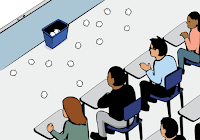
“By contrast, people in the front of the room were less likely to be aware of the privilege they were born into. All they can see is 10 feet between them and their goal.”
“Your job — as students who are receiving an education — is to be aware of your privilege. And use this particular privilege called “education” to do your best to achieve great things, all the while advocating for those in the rows behind you.”
What did you think? Did this teacher get it right? Leave us your comments, we love hearing from you.
Then he moved the recycling bin to the front of the room.
He said, “The game is simple — you all represent the country’s population. And everyone in the country has a chance to become wealthy and move into the upper class.”
“To move into the upper class, all you must do is throw your wadded-up paper into the bin while sitting in your seat.”

The students in the back of the room immediately piped up, “This is unfair!” They could see the rows of students in front of them had a much better chance.
Everyone took their shots, and — as expected — most of the students in the front made it (but not all) and only a few students in the back of the room made it.

He concluded by saying, “The closer you were to the recycling bin, the better your odds. This is what privilege looks like. Did you notice how the only ones who complained about fairness were in the back of the room?”

“By contrast, people in the front of the room were less likely to be aware of the privilege they were born into. All they can see is 10 feet between them and their goal.”
“Your job — as students who are receiving an education — is to be aware of your privilege. And use this particular privilege called “education” to do your best to achieve great things, all the while advocating for those in the rows behind you.”
What did you think? Did this teacher get it right? Leave us your comments, we love hearing from you.
#borntoteach #GoAthenahttp://bit.ly/Athena-BCS
Posted by Athena Learning Center - College Station on Tuesday, November 3, 2015
Saturday, October 31, 2015
Thursday, October 29, 2015
Making Halloween Educational for Kids

source: https://www.kaplanco.com/blog/post/2014/10/02/Making-Halloween-Educational-for-Kids.aspx
How do you plan to celebrate Halloween in your classroom? Will you have a costume parade, throw a Halloween party, decorate pumpkins, or pass out lots of candy? These and other similar activities will only add to children’s excitement about the holiday, but Halloween-related activities aren’t usually the most educational of activities you can plan for students. In fact, some people may say that these types of activities are a waste of time and resources.
While you can argue that Halloween activities promote family engagement and community in the classroom, intentional teaching (consciously planning activities that have specific purposes) can help you silence the naysayers and make Halloween more educational for kids. Here are four ways you can create satisfying (and fun!) Halloween-related learning experiences for the children in your care:
1. Share Fun Facts - Did you know pumpkins are a fruit? They’re actually berries—yes, berries (we were shocked, too). Providing fun, interesting facts about pumpkins, bats, and other Halloween-related objects and animals can help make any Halloween activity educational for kids. Helpful Tip: Turn the fun facts you come up with into a trivia game that students can play during your Halloween party or while they’re decorating pumpkins.
2. Go Beyond Arts and Crafts - Take students to a local pumpkin patch and let them pick out their own pumpkin for decorating. This is a great opportunity for children to learn about how pumpkins are grown. If you don’t have the budget to go on a field trip, read Pumpkin Pumpkin with your class or ask a local pumpkin farmer to come talk to your class about the growing process. Helpful Tip: Before children decorate their pumpkin, have them record their observations about the pumpkin’s size, color, shape, and other features. You can use their data to create fun and relatable math charts and word problems.
3. Learn About Various Halloween Celebrations - Halloween has a long history and is celebrated in a


4. Turn Your Halloween Party into a Halloween Math Party! - Have children estimate how many candy corns or roasted pumpkin seeds are in a jar. Pass out candy and ask students to count or sort their candy pieces. Older children can also use candy pieces to make fractions or practice addition, subtraction, multiplication, and division. Helpful Tip: Invite parents to come to your Halloween math party and/or take pictures of students solving math problems and enjoying their snacks. You can post the pictures you take on your classroom blog or send them to parents in an email or newsletter.
So what is your creative idea to keep the kiddos learning? Don't let all that candy turn their brains into mush. Leave us a comment with your best idea.
Athena Learning Center of College Station
Tuesday, October 27, 2015
Unaffordable Tutoring and How It Can Be Fixed

Tutoring and affordability is a subject that is very near and dear to our hearts here at Athena. We deal with it every day. We would love to see professional, quality tutoring available and affordable to every child who needs it. While our legislature has made some attempts to deal with the problem, they are often short sighted and lacking. What's worse, the children who some of these programs were designed to help the most are often ineligible due to technicalities that weren't very well thought out. This article deals with the subject very well. Look for more insights at the end.
source: http://www.teenink.com/opinion/social_issues_civics/article/793307/Unaffordable-Tutoring-and-How-It-Can-Be-Fixed/


Have you ever struggled in school? A common solution to that problem is to hire a tutor. However, a problem today is the lack of affordable tutoring for those in need of it. Providing more academic aid to students can help them get better grades and hopefully get into a better college.
The fee for a tutor can range from $10 for a high school student to $75 for a certified teacher per hour. This can be extremely expensive, especially if a student receives frequent tutoring. Students and parents in lower income areas may be unwilling to spend that extra money or be unable to afford it, but students who can afford it gain an advantage over others who cannot and have been shown to have significantly higher mean scores in both language arts and math standardized tests when compared to an untutored control group.
In 2012, over 50% of students in U.S. public schools were considered low income for the first time in
 at least 50 years. A lack of affordable tutoring is an increasingly large issue that now affects the majority of public high school students and the gap between low-income and wealthier students is only increasing.
Students should be given as equal a chance as possible to do well in school, regardless of their economic situation and should be able to receive extra help if needed. Tutors can focus on a specific student’s needs, which is often hard to accomplish in large groups.
 It was due to similar concerns that Congress passed its No Child Left Behind Act in 2001. The goal of the act is to provide federal funds to schools with poor students and “improve educational equity for students from lower income families”.
Although the act can also cover tutoring costs, less than 15% of eligible students are currently receiving it. Also, districts are only qualified if they attend Title I schools, which are school districts with at least 35% of students’ families categorized as low income. Students are qualified if they attend the district and receive a free or reduced-price lunch.
Much more can be done to raise awareness of these programs and further encourage students to seek tutoring, especially if the costs are covered under the act. Since the program already exists, people should be encouraged to us it. However, one issue with the No Child Left Behind Act is that it caused a rise in companies charging the maximum covered by the act of $2,000 per student for 50 hours for unqualified tutors. This problem can be solved by an increase in oversight and increased monitoring of the tutoring companies, which would save money being spent on overpriced, unqualified tutors.
While the No Child Left Behind Act does help many of those who need it, it only targets those in
 relatively high-poverty areas. Those attending school districts that don’t meet the criteria or whose families are not considered low-income are not affected, even if they need it.
A solution to this problem is volunteer tutoring. Many high school and some college students are required to provide community service and many are members of community service organizations that are willing to help. Tutoring could also be beneficial to the elderly and retired - a study in 2009 indicates that tutoring can delay or reverse brain aging in the elderly. Another study found that tutoring led to measurable improvements in physical activity and mental health of the tutors over those who did not.
Organizations such as the Experience Corps, which tutors in 22 cities across the nation, are already working with the interested elderly. Tutors receive no income other than “an annual stipend of about $2,800 that helps cover transportation costs, school lunches and occasional treats for the kids”.
 Programs like the Experience Corps should be more widely implemented and in more flexible groups so that a wider range of people can participate. Funding could come from donations and from states or the federal government. Funds are already being used for the No Child Left Behind Act and some could be used for volunteer programs, which could also reduce existing costs for other tutoring under the act.
The fee for a tutor can range from $10 for a high school student to $75 for a certified teacher per hour. This can be extremely expensive, especially if a student receives frequent tutoring. Students and parents in lower income areas may be unwilling to spend that extra money or be unable to afford it, but students who can afford it gain an advantage over others who cannot and have been shown to have significantly higher mean scores in both language arts and math standardized tests when compared to an untutored control group.
In 2012, over 50% of students in U.S. public schools were considered low income for the first time in

Students should be given as equal a chance as possible to do well in school, regardless of their economic situation and should be able to receive extra help if needed. Tutors can focus on a specific student’s needs, which is often hard to accomplish in large groups.

Although the act can also cover tutoring costs, less than 15% of eligible students are currently receiving it. Also, districts are only qualified if they attend Title I schools, which are school districts with at least 35% of students’ families categorized as low income. Students are qualified if they attend the district and receive a free or reduced-price lunch.
Much more can be done to raise awareness of these programs and further encourage students to seek tutoring, especially if the costs are covered under the act. Since the program already exists, people should be encouraged to us it. However, one issue with the No Child Left Behind Act is that it caused a rise in companies charging the maximum covered by the act of $2,000 per student for 50 hours for unqualified tutors. This problem can be solved by an increase in oversight and increased monitoring of the tutoring companies, which would save money being spent on overpriced, unqualified tutors.
While the No Child Left Behind Act does help many of those who need it, it only targets those in

A solution to this problem is volunteer tutoring. Many high school and some college students are required to provide community service and many are members of community service organizations that are willing to help. Tutoring could also be beneficial to the elderly and retired - a study in 2009 indicates that tutoring can delay or reverse brain aging in the elderly. Another study found that tutoring led to measurable improvements in physical activity and mental health of the tutors over those who did not.
Organizations such as the Experience Corps, which tutors in 22 cities across the nation, are already working with the interested elderly. Tutors receive no income other than “an annual stipend of about $2,800 that helps cover transportation costs, school lunches and occasional treats for the kids”.

What amazes me is that well intentioned programs like No Child Left Behind can have such overarching requirements like the child can only be in a Title 1 school. So basically, if you are a poor kid in a rich school, you are out of luck. I understand the thoughts behind it like richer schools should be able to supplement tutoring for poor students easier than poor schools, instead of having nicer football stadiums, or huge marching bands, or....I better just stop there. And don't get me started on blithely handing out ipads to every student thinking this will magically jump them into the 21st century. See an entire article we published about that here: http://athenabcs.blogspot.com/2015/10/why-ipads-and-chromebooks-wont-save.html
So what do you think? What are some of the more pressing concerns we have when it comes to our poorer students? How can we help them best? Leave your comments below.
Subscribe to:
Posts (Atom)